



Author(s): Megan Townsend
Over the past several years, Computer Science has been a field associated with strong demand and high wages, yet the advancement of artificial intelligence (AI) and broader changes in the technology labor market have introduced new uncertainties about the field’s future. Using data from the Common Follow-up System (CFS), this article examines two decades of Computer Science1 graduates from UNC System schools to better understand how changing employment and wage patterns may inform the outlook for these graduates.
Strong growth in computer science graduates
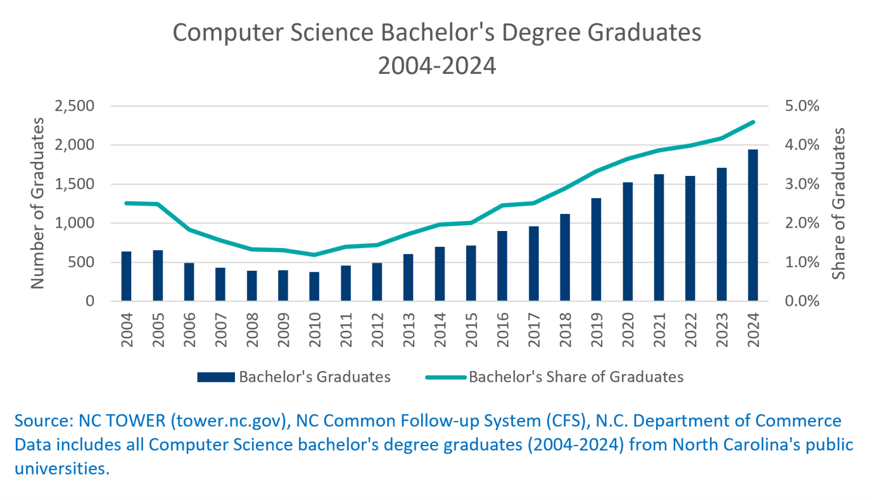
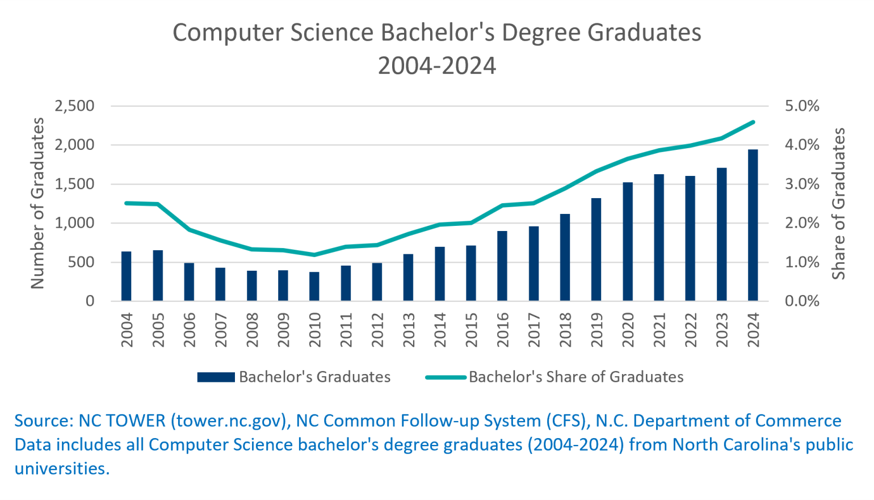
After declining enrollment from 2005 to 2010, the number of Computer Science bachelor’s degree graduates grew sharply. Between 2010 and 2024, the number of annual graduates increased from 376 to 1,944. Computer Science graduates accounted for just over one percent of all bachelor’s degree graduates in 2010; by 2024, this share had grown to 4.6 percent, signaling rising student interest.
People are also reading…
Figure 1
Computer Science Bachelor’s Degree Graduates from UNC System Schools
Shifts in employment across major sectors
Employment outcomes were analyzed at two and ten years after graduation across four major sectors: Information, Financial Activities, Manufacturing, and Professional & Business Services. Employment was most concentrated in the Professional & Business Services sector, though its share of early-career employment declined for the 2022 and 2023 cohorts. The Financial Activities sector saw its share of early-career employment rise from roughly ten percent for the 2004 cohort to nearly 18 percent for the 2022 cohort.
Manufacturing, which was the second-largest employment sector of early-career graduates prior to the 2009 cohort, experienced a steady decline in employment share over time. This pattern may reflect changing demand for Computer Science graduates across industries.
Early-career employment rates declined across all sectors for the 2023 cohort. This broad decline suggests a tightening labor market for recent graduates. Fluctuations were not limited to early-career workers. Employment rates among more experienced graduates in the Professional & Business Services sector also declined between the 2014 and 2015 cohorts, suggesting that shifts in demand may be affecting both new and established workers. Rates of employment in the four sectors over time are presented in Figure 2.
Figure 2
Computer Science Graduates’ Employment by Sector
Wage trends reveal sector-specific declines
Wage patterns offer additional insight into changing labor market conditions. By 2008, average wages in the Information sector surpassed those in Financial Activities, and by 2009 they overtook Manufacturing. Except for the 2012 cohort, the Information sector remained the highest paying sector for Computer Science graduates at the ten-year mark.
Manufacturing, among the highest paying sectors for Computer Science graduates in the early 2000s, experienced pronounced wage declines, particularly for mid-career workers. This aligns with the sector’s declining employment share.
Early-career wages within the Information, Manufacturing, and Professional & Business Services sectors declined for the 2023 cohort. These trends correspond to findings reported in the July 2025 NC Economy Watch, which documented wage declines among recent Computer & Information Sciences & Support Services graduates. Figure 3 presents inflation-adjusted average wages in the second and tenth years after graduation for major sectors.
Figure 3
Computer Science Graduates’ Average Wage2 by Sector
Implications for North Carolina
The substantial rise in Computer Science graduates between 2010 and 2024 reflects growing student interest in technology careers and the continued demand for Computer Science talent across the economy. However, recent cohorts have faced a more challenging landscape. Early-career employment rates have declined in the major sectors, and average early-career wages have declined in the Information, Manufacturing, and Professional & Business & Services sectors.
The 2023 cohort may represent an important turning point, entering the labor market shortly after the widespread introduction of generative AI tools and during a period of broader adjustment in technology hiring. Whether these recent trends represent a temporary labor market adjustment or the beginning of a longer-term structural shift remains an important question for policymakers, educators, employers, and students.
The Manufacturing sector also shows a longer-term shift. Once a major employer with high wages for Computer Science graduates, Manufacturing has experienced a steady decline in both employment share and wage outcomes.
These developments may signal heightened competition for positions among new graduates and could reflect broader changes in the technology labor market, including the adoption of AI-driven tools and evolving workforce needs. How these changes will shape the long‑term outlook for Computer Science graduates remains an important question for policymakers, educators, and students. Continued monitoring of future graduate outcomes will help determine whether these recent trends represent a temporary labor market adjustment or a long-term structural shift. Ensuring that academic programs remain aligned with evolving technologies and workforce needs will be essential in sustaining strong outcomes for future graduates.


