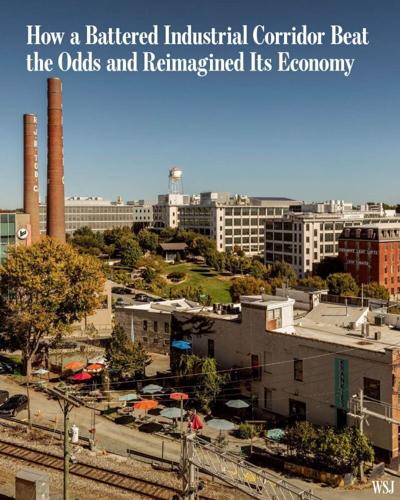
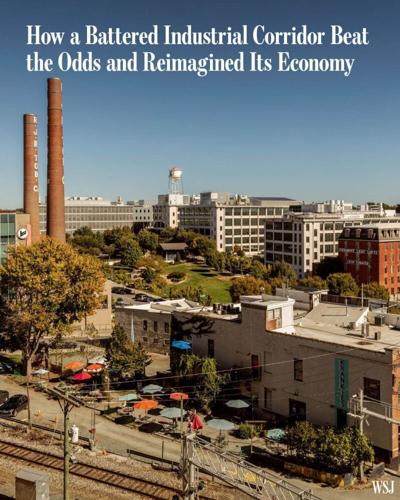
North Carolina's Piedmont Triad, a region once known for its textile, tobacco and furniture-making industries—until they were battered by globalization and offshoring in the 1990s and 2000s—is transforming.
Anchored by Greensboro, Winston-Salem and High Point, the Triad has pulled off an unusual feat that has eluded many areas hit by deindustrialization: It reinvented its economy. The region is now a center for aerospace, advanced manufacturing, life sciences and logistics.
Political and business leaders in the Triad say a high tolerance for risk helped. Economic-development groups rolled the dice with big public and private investments in land and infrastructure to try to lure new industries.
City chambers of commerce in the Triad banded together to pitch the region collectively to companies, rather than competing against one another.
North Carolina’s swing-state status, with a Democratic governor and Republican-led state Senate, has pushed the parties to work together on economic development, some officials say.
The Triad’s resurgence is helping turn North Carolina into a major draw. The state in recent years has bypassed much bigger Texas and Florida as a destination for net domestic migration—people arriving from other states minus those leaving to other states—according to the Census Bureau.
Affordability has helped, too: In the second quarter this year, the Triad’s median home price was $304,000, compared with $409,000 in the Raleigh-area Research Triangle and $413,000 in the Charlotte area, said Tony Jarrett, a regional vice president at Howard Hanna Allen Tate Real Estate. The median home price in the U.S. as a whole was $408,000 in June, according to Redfin.
This content is sourced from
High Point
. It reflects the author's views and has not been edited by our newsroom. It may have been generated using AI assistance.